Two specialists each learned half of efficient reasoning. Weave both halves into one student.
Overview · 1 min
The paper in one minute.
Animated from the talk slides. No sound.
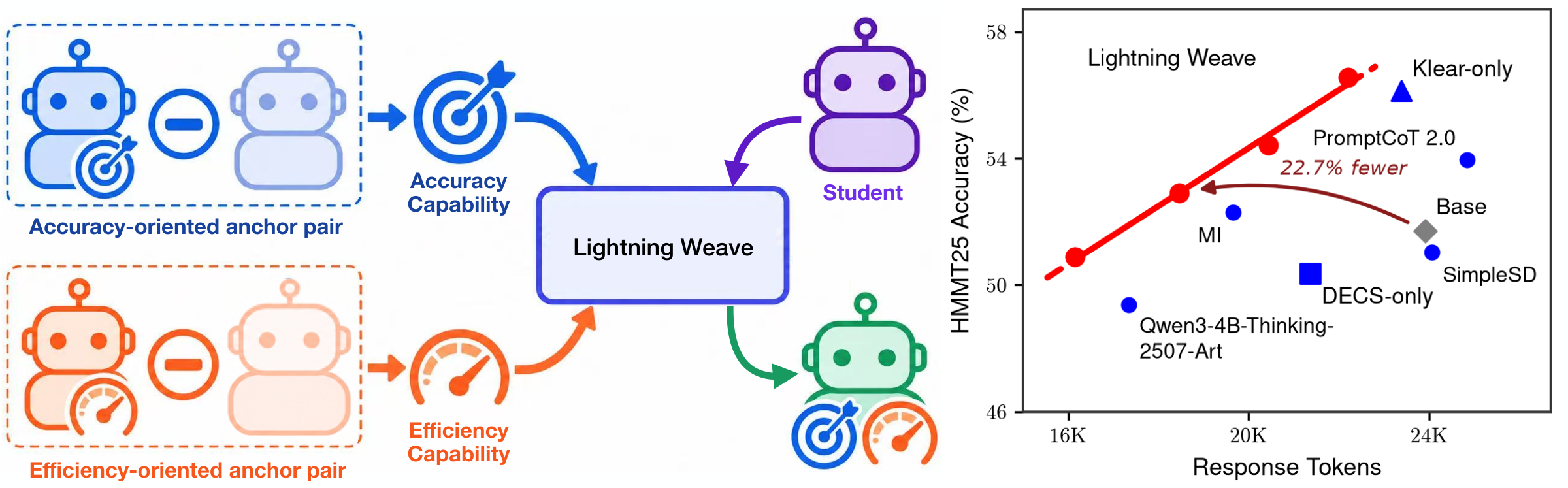
TL;DRLightning Weave takes what independently post-trained specialists already learned, an accuracy shift from Klear and an efficiency shift from DECS, and composes them at every token of the student's own reasoning. A tilted target keeps offline training stable, so each anchor pair scores the data once and the student then trains alone. On all five students tested, the result is more accurate and shorter than the base model.
+9.70ptsAverage accuracyQwen3.5-4B · 55.16 → 64.86 over five benchmarks
−19.7%Response tokensQwen3-4B · 15,723 → 12,628
64.0%HMMT 2025Qwen3.5-4B · from 59.2%, with 10.7% fewer tokens
54.2%LiveCodeBench v5Qwen3.5-4B · from 41.7%, with 9.6% fewer tokens
5/ 5Best AESevery student, vs. base and single-anchor policies
1.84×Fewer GPU-hoursthan online DOPD · Qwen3-4B, two anchors
Figure 1 of the paper. Left: each anchor pair isolates one capability, and Lightning Weave composes both into a single student. Right: on Qwen3-4B-Thinking-2507, changing the relative strength of the two capabilities traces an HMMT 2025 frontier.
Abstract
A core goal of efficient reasoning is to improve the accuracy–efficiency frontier. However, jointly improving reasoning accuracy and inference efficiency can be challenging, as the two objectives can favor different reasoning behaviors. Independently post-trained models already offer distinct strengths in accuracy and efficiency. We introduce Lightning Weave, a post-training framework that extracts and composes these independently learned capabilities in a single student through on-policy distillation. Each acquired capability is represented by the policy shift from the model before post-training to the resulting specialist. Lightning Weave combines aligned log-ratio shifts at shared student token states and uses Tilted-Target DOPD to convert the cached signals into a stable learning target. Each anchor pair scores the cached trajectories once, enabling subsequent student training without serving multiple live anchor models concurrently. Across diverse student models and benchmarks in mathematics and code, Lightning Weave substantially improves upon the base students and achieves a state-of-the-art accuracy–efficiency frontier. On Qwen3.5-4B, it raises HMMT 2025 accuracy from 59.2% to 64.0% with 10.7% fewer response tokens, and LiveCodeBench v5 accuracy from 41.7% to 54.2% with 9.6% fewer response tokens. Adjusting the relative strengths of the anchor signals yields a strong empirical accuracy–efficiency Pareto frontier.
01 · Method
Extract each skill. Weave it per token. Distill offline.
Accuracy and efficiency pull reasoning in different directions, so training for both at once is hard. Specialists that already learned each one exist. Lightning Weave transfers what they learned through the student's own outputs, so the anchors can differ from the student in size and family.
Roll outStudent rolloutssampled once from the initial student and cached
Anchor pairs score oncelog-ratio of each specialist to its pre-training checkpoint
WeaveComposed shiftweighted sum at every shared token state
Tilt
→
Explicit targetthe behavior policy tilted by the composed shift
Distill
Student onlyfits the target by KL; no anchor model is served during training
1
A capability is a policy shift
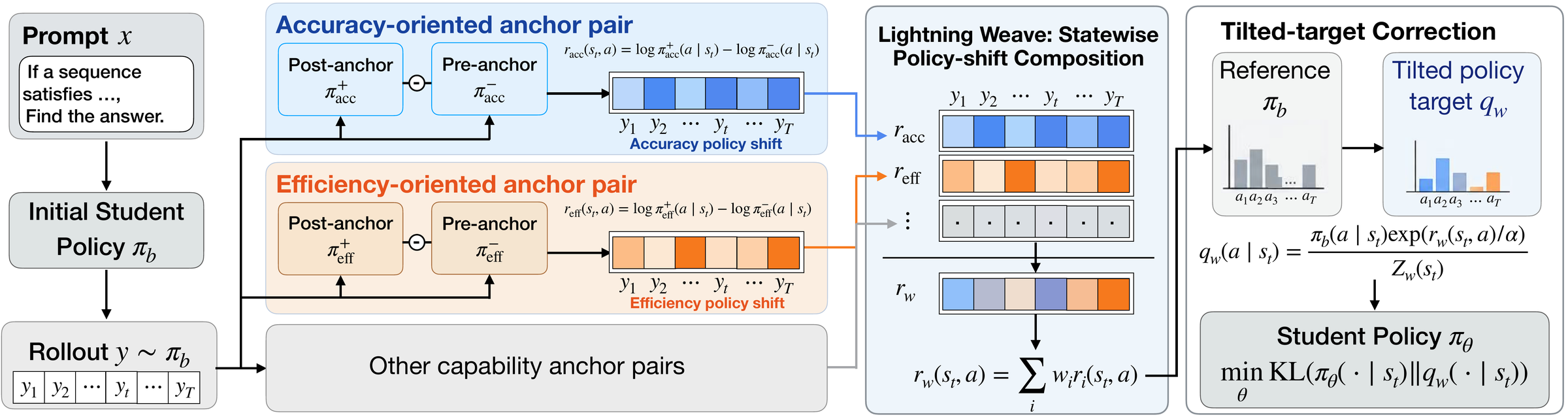
Pair each specialist π+ with its checkpoint before post-training π−. Their token-level log-ratio keeps what post-training changed and drops what the base already knew.
All anchor pairs score the same student rollouts, so their shifts line up token by token. Shifts that agree reinforce each other, conflicts are settled locally, and the weights set the balance.
The composed shift tilts the frozen behavior policy into one explicit target, and the student minimizes its KL to that target. The loss and gradient vanish once the student reaches it, which makes offline training stable.
Online, two capabilities mean four anchor models served next to the student at every step. Here each pair scores the cached rollouts once, following Lightning OPD, and training needs only the student and the cached scores. One cache serves every weighting.
Qwen3-4B, two anchors, 100 rounds: 9.58 GPU-h vs. 17.64 for online DOPD (1.84×).
Figure 2 of the paper. (1) Capability-specific policy shifts on shared student token states. (2) Statewise multi-anchor composition. (3) Tilted-target distillation.
02 · Tilted target
Cached shifts need a destination.
Reusing DOPD's sampled-token objective on a fixed cache keeps pushing after the shift has been absorbed, because its KL penalty is estimated on cached actions that the student has moved away from. The tilted target gives training a fixed point. It matches online DOPD without serving any anchor.
Average over five benchmarks · Qwen3-4B
From Table 4(a) of the paper. Matched student initialization, prompt sequence, trajectory budget and update budget within each setting. The dashed line marks the base model's 15,723 tokens.
03 · Main results
More accurate and shorter, on every student.
Klear + DECS at equal weights, on five students across Qwen3, Qwen3.5 and OLMo-3. Averages over AIME 2024, AIME 2025, HMMT 2025 and LiveCodeBench v5 and v6.
Base modelLightning Weave
Per-benchmark results
Acc. = mean accuracy (%), Avg@64 for math and Avg@4 for code. Tok. = mean response tokens. AES = accuracy–efficiency score against the base model. Bold marks the best value per column. From Table 1 of the paper.
04 · Frontier
Turn one weight, choose the operating point.
Each weight is one student trained from the same cache. More DECS weight shortens responses, and the middle weights keep or raise accuracy. The non-dominated students trace a Pareto frontier over the base, both single anchors and four other methods.
Qwen3-4B-Thinking-2507, from Table 2 of the paper. Other methods: SimpleSD, Qwen3-4B-Thinking-2507-Art, PromptCoT 2.0 and model interpolation (MI, λ = 0.8). The 0.5 student is the one in the main results. Solid line: non-dominated students; dashed: dominated ones.
05 · Token budgets
Largest gains when tokens are scarce.
Every AIME 2024 response is cut at 4K, 8K and 16K tokens and graded again. Lightning Weave leads at every cap, by 6 or more points over the better single anchor up to 16K.
BaseKlear onlyDECS onlyLightning Weave
+11.4 pts at 8K
Qwen3-4B-Thinking-2507, 64 samples on each of the 30 problems. Responses are truncated with the Qwen3 tokenizer and re-graded with the same answer checker. The 32K point is the original evaluation. From Figure 3(c) of the paper.
06 · Analysis
Weaving beats mixing and sequencing, and takes more anchors.
How to combine two anchors
AES 0.41
Against data mixture: +1.24 points with 7.1% fewer tokens. Sequential training is order-sensitive, and whichever anchor goes last wins.
Qwen3-4B, matched data and updates. From Table 4(b) of the paper.
Adding MiMo-RL as a third anchor
62.50% · AES 0.42
All three anchors: +6.6 points over the base with 5.4% fewer tokens. Adding an anchor moves the student toward that anchor's capability.
Qwen3-4B, equal weights. From Table 3 of the paper.
Training cost, GPU-hours for one composition
1.70–2.18× cheaper
Online DOPDRolloutsStudent-reference scoringAnchor scoringStudent-only training
100-round settings; CPU target construction excluded. From Table 6 of the paper.
Citation
BibTeX
@article{wu2026lightningweave,
  title={Lightning Weave: Improving the Accuracy-Efficiency Frontier of Reasoning Models through Capability Composition},
  author={Wu, Yecheng and Han, Song and Cai, Han},
  journal={arXiv preprint arXiv:2609.14708},
  year={2026}
}